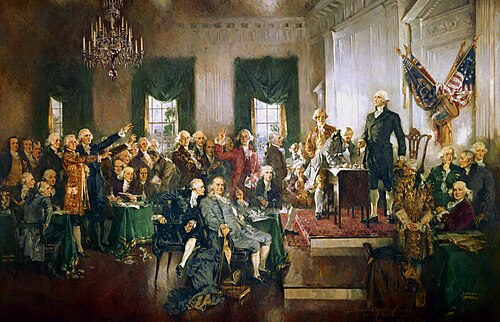
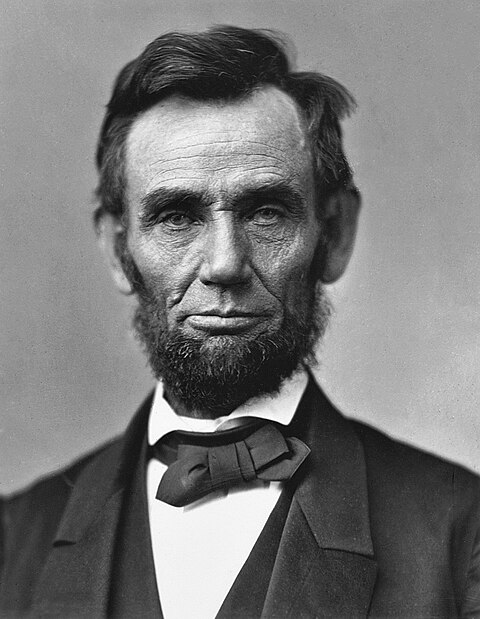
These are the supreme laws of the land — ratified by the people, for the people. Read them. Know them. They are your shield against tyranny and your declaration of liberty.
❧
❧
The Bill of Rights
Amendments I–X · Ratified December 15, 1791
✦
I
First Amendment
Freedom of Religion, Speech, Press, Assembly & Petition
Ratified December 15, 1791
"Congress shall make no law respecting an establishment of religion, or prohibiting the free exercise thereof; or abridging the freedom of speech, or of the press; or the right of the people peaceably to assemble, and to petition the Government for a redress of grievances."
The cornerstone of American liberty. The First Amendment protects five fundamental freedoms: religion, speech, press, assembly, and petition. No government may silence your voice, control your worship, or prevent peaceful protest.
"A well regulated Militia, being necessary to the security of a free State, the right of the people to keep and bear Arms, shall not be infringed."
The Second Amendment protects the individual right to possess firearms. The Supreme Court confirmed in District of Columbia v. Heller (2008) that this is an individual right unconnected to militia service, though subject to reasonable regulation.
"No Soldier shall, in time of peace be quartered in any house, without the consent of the Owner, nor in time of war, but in a manner to be prescribed by law."
Born from colonial grievances against British soldiers being forcibly housed in private homes, the Third Amendment guarantees the sanctity of your home against military intrusion. It is the least litigated of all amendments but foundational to the concept of home privacy.
Protection Against Unreasonable Search and Seizure
Ratified December 15, 1791
"The right of the people to be secure in their persons, houses, papers, and effects, against unreasonable searches and seizures, shall not be violated, and no Warrants shall issue, but upon probable cause, supported by Oath or affirmation, and particularly describing the place to be searched, and the persons or things to be seized."
Police must generally obtain a warrant based on probable cause before searching your home, car, or person. Evidence obtained through illegal searches may be excluded from court under the exclusionary rule established in Mapp v. Ohio (1961).
"No person shall be held to answer for a capital, or otherwise infamous crime, unless on a presentment or indictment of a Grand Jury... nor shall any person be subject for the same offence to be twice put in jeopardy of life or limb; nor shall be compelled in any criminal case to be a witness against himself, nor be deprived of life, liberty, or property, without due process of law..."
You cannot be tried twice for the same crime (double jeopardy), compelled to testify against yourself ("pleading the Fifth"), or deprived of life, liberty, or property without due process. Miranda v. Arizona (1966) extended these protections to police interrogations.
"In all criminal prosecutions, the accused shall enjoy the right to a speedy and public trial, by an impartial jury... to be informed of the nature and cause of the accusation; to be confronted with the witnesses against him; to have compulsory process for obtaining witnesses in his favor, and to have the Assistance of Counsel for his defence."
You have the right to a fast, public trial by jury, to know the charges against you, to confront your accusers, and to have an attorney. Gideon v. Wainwright (1963) established that the government must provide a lawyer if you cannot afford one.
"In Suits at common law, where the value in controversy shall exceed twenty dollars, the right of trial by jury shall be preserved, and no fact tried by a jury, shall be otherwise re-examined in any Court of the United States, than according to the rules of the common law."
In federal civil cases involving more than $20 (adjusted by modern context to significant sums), you have the right to a jury trial. This preserves the people's role in resolving civil disputes rather than leaving all decisions to judges.
"Excessive bail shall not be required, nor excessive fines imposed, nor cruel and unusual punishments inflicted."
Bail must be proportional to the crime. Punishments cannot be barbaric or grossly disproportionate. This amendment has been the basis of challenges to the death penalty, solitary confinement conditions, and excessive prison sentences.
"The enumeration in the Constitution, of certain rights, shall not be construed to deny or disparage others retained by the people."
Just because a right isn't listed in the Constitution doesn't mean it doesn't exist. The Founders understood they could not enumerate every right of a free people. This amendment is a recognition that the people are the source of all rights, not the government.
"The powers not delegated to the United States by the Constitution, nor prohibited by it to the States, are reserved to the States respectively, or to the people."
The federal government only has the powers explicitly given to it by the Constitution. All other powers belong to the states or the people. This is the foundation of federalism — the structural limit on federal overreach.
"The Judicial power of the United States shall not be construed to extend to any suit in law or equity, commenced or prosecuted against one of the United States by Citizens of another State, or by Citizens or Subjects of any Foreign State."
Protects states from being sued in federal court by citizens of other states or foreign nations without their consent. Passed after Chisholm v. Georgia (1793) shocked states by allowing such suits.
XII
Twelfth Amendment
Presidential Election Process
Ratified June 15, 1804
Revised the Electoral College process so electors cast separate ballots for President and Vice President, fixing the flaw that caused the tied election of 1800 between Thomas Jefferson and Aaron Burr.
Before this amendment, the runner-up in the presidential election became Vice President — leading to the disastrous Jefferson-Burr tie. The 12th Amendment created the modern ticket system of President and Vice President.
XIII
Thirteenth Amendment
Abolition of Slavery
Ratified December 6, 1865
"Neither slavery nor involuntary servitude, except as a punishment for crime whereof the party shall have been duly convicted, shall exist within the United States, or any place subject to their jurisdiction."
Ratified eight months after the Civil War ended, the 13th Amendment permanently abolished slavery in the United States — fulfilling the promise of the Declaration of Independence that all men are created equal.
XIV
Fourteenth Amendment
Citizenship, Equal Protection & Due Process
Ratified July 9, 1868
"All persons born or naturalized in the United States... are citizens of the United States and of the State wherein they reside. No State shall... deprive any person of life, liberty, or property, without due process of law; nor deny to any person within its jurisdiction the equal protection of the laws."
One of the most consequential amendments. It extended citizenship to formerly enslaved people and applied constitutional protections against state governments. The Equal Protection Clause has been the foundation of civil rights law for over 150 years.
XV
Fifteenth Amendment
Right to Vote Regardless of Race
Ratified February 3, 1870
"The right of citizens of the United States to vote shall not be denied or abridged by the United States or by any State on account of race, color, or previous condition of servitude."
Granted Black men the right to vote after the Civil War. Despite passage, states used poll taxes, literacy tests, and violence to suppress Black voting for nearly a century until the Voting Rights Act of 1965.
XVI
Sixteenth Amendment
Federal Income Tax
Ratified February 3, 1913
"The Congress shall have power to lay and collect taxes on incomes, from whatever source derived, without apportionment among the several States, and without regard to any census or enumeration."
Authorized the federal income tax after the Supreme Court struck down a previous income tax in 1895. This amendment fundamentally changed the relationship between the federal government and American citizens and finances.
XVII
Seventeenth Amendment
Direct Election of Senators
Ratified April 8, 1913
Established direct popular election of U.S. Senators. Previously, senators were chosen by state legislatures — a system rife with corruption and deadlock.
Before 1913, voters had no direct say in who represented them in the Senate. This amendment transferred that power directly to the people, a major expansion of democratic participation.
XVIII
Eighteenth Amendment
Prohibition of Alcohol
Ratified January 16, 1919
Prohibited the manufacture, sale, or transportation of intoxicating liquors. It is the only constitutional amendment to have been fully repealed.
Prohibition lasted from 1920 to 1933 and gave rise to organized crime, bootlegging, and speakeasies. It is widely considered one of the great policy failures in American history, ultimately repealed by the 21st Amendment.
XIX
Nineteenth Amendment
Women's Right to Vote
Ratified August 18, 1920
"The right of citizens of the United States to vote shall not be denied or abridged by the United States or by any State on account of sex."
After 72 years of struggle by the suffragette movement, women won the right to vote. The amendment doubled the eligible voting population overnight and was a landmark moment in American democracy.
XX
Twentieth Amendment
Presidential & Congressional Terms (Lame Duck)
Ratified January 23, 1933
Moved the start of presidential and congressional terms to January 20 and January 3 respectively, reducing the "lame duck" period between election and inauguration.
Previously, defeated officials served from March — months after losing — creating a long period of ineffective government. The 20th Amendment shortened this to reduce political limbo and ensure faster transitions of power.
XXI
Twenty-First Amendment
Repeal of Prohibition
Ratified December 5, 1933
Repealed the Eighteenth Amendment, ending the national prohibition of alcohol. It is the only amendment in U.S. history to repeal a prior amendment.
After 13 years of Prohibition fueling crime and corruption, the nation reversed course. The 21st Amendment is a testament to the Constitution's capacity for self-correction when policy fails the people.
XXII
Twenty-Second Amendment
Presidential Term Limits
Ratified February 27, 1951
No person shall be elected to the office of President more than twice, nor serve more than ten years total if they assumed the presidency without being elected to it.
Passed in response to Franklin D. Roosevelt's unprecedented four terms. The amendment codified George Washington's two-term tradition into law, preventing any individual from holding executive power indefinitely.
XXIII
Twenty-Third Amendment
Electoral Votes for Washington D.C.
Ratified March 29, 1961
Granted Washington D.C. electoral votes in presidential elections — at least three, as if it were a state — giving D.C. residents the ability to vote for President for the first time.
Before 1961, the more than 750,000 residents of the nation's capital had no voice in presidential elections. This amendment corrected that democratic deficit, though D.C. still has no voting representation in Congress.
XXIV
Twenty-Fourth Amendment
Abolition of Poll Taxes
Ratified January 23, 1964
"The right of citizens of the United States to vote in any primary or other election for President or Vice President... shall not be denied or abridged by the United States or any State by reason of failure to pay any poll tax or other tax."
Poll taxes were used across the South to prevent poor Black Americans from voting. The 24th Amendment eliminated this tool of voter suppression in federal elections, a critical step in the civil rights movement.
XXV
Twenty-Fifth Amendment
Presidential Succession & Disability
Ratified February 10, 1967
Establishes the order of presidential succession and procedures for handling presidential disability, including the Vice President's ability to assume power when the President is incapacitated.
Passed after the Kennedy assassination exposed gaps in succession law. The 25th Amendment provides clear procedures for when a president is unable to serve, preventing power vacuums at the highest level of government.
XXVI
Twenty-Sixth Amendment
Voting Age Lowered to 18
Ratified July 1, 1971
"The right of citizens of the United States, who are eighteen years of age or older, to vote shall not be denied or abridged by the United States or by any State on account of age."
Driven by Vietnam War protests — if 18-year-olds could be drafted and die for their country, they should be able to vote. Passed the fastest of any amendment, ratified in just 100 days after Congress sent it to the states.
XXVII
Twenty-Seventh Amendment
Congressional Pay Changes
Ratified May 7, 1992
"No law, varying the compensation for the services of the Senators and Representatives, shall take effect, until an election of Representatives shall have intervened."
Originally proposed by James Madison in 1789 as part of the original Bill of Rights, this amendment took 203 years to ratify — the longest ratification in history. It prevents Congress from voting itself an immediate pay raise, requiring an election before any increase takes effect.
You know your rights. Now stand and be counted. Claim your permanent spot on the We The People Patriot Wall alongside fellow Americans who refuse to forget.